Personal value experiment / The Price of Going Back
The Price of Going Back
A personal value experiment, explored one loss at a time.
The experiment
“Is life better now?” is a large, abstract question. The Price of Going Back makes it personal: imagine losing a specific capability or protection, then ask what recurring compensation you would require to live without it.
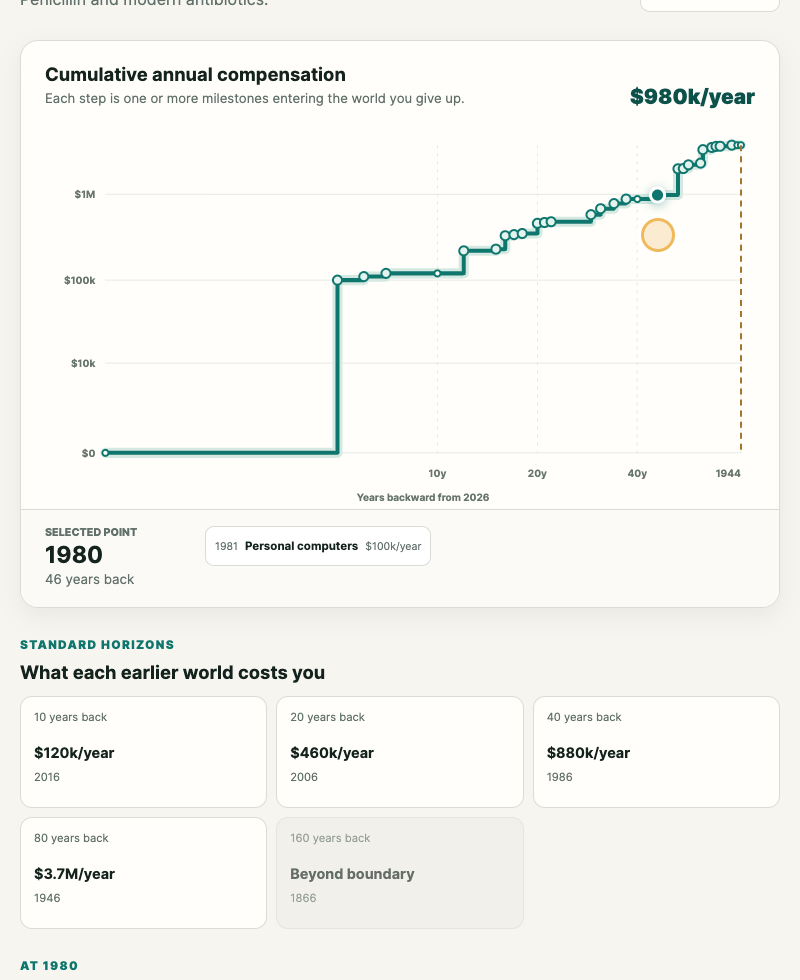
The experience moves from individual judgments to a graph. You can inspect the combined picture and reconsider the answers behind it.
Rules
- Name the loss. Be specific about what disappears and what remains in the earlier world.
- Make a judgment. Compensation is annual and can buy only what exists in that world. A price cannot purchase an absent medicine or right.
- Keep refusal meaningful. “Invaluable” creates a stopping boundary. It is not silently converted into a very large number.
- Inspect the curve. The combined responses are a picture to question, including possible overlap and missing milestones.
Why a personal graph?
A single score would hide which losses mattered and where a participant refused the trade. A curve makes those judgments inspectable across the imagined journey into the past.
The idea model and the application have separate roles: the model states the definitions and proposed checks; the application lets someone experience a particular interpretation.
What it shows—and what remains open.
The working experience turns individual answers into a participant-specific curve. It does not establish an objective price of progress, a market value, or a measure of social welfare.
How stable are answers when questions are reordered? Do participants understand the imagined world in the same way? Do combined losses expose double counting? These are research questions, not demonstrated outcomes.
A useful way to try it
Answer before looking at someone else’s curve. Then compare the capabilities you refused to lose, and the assumptions behind your answers.